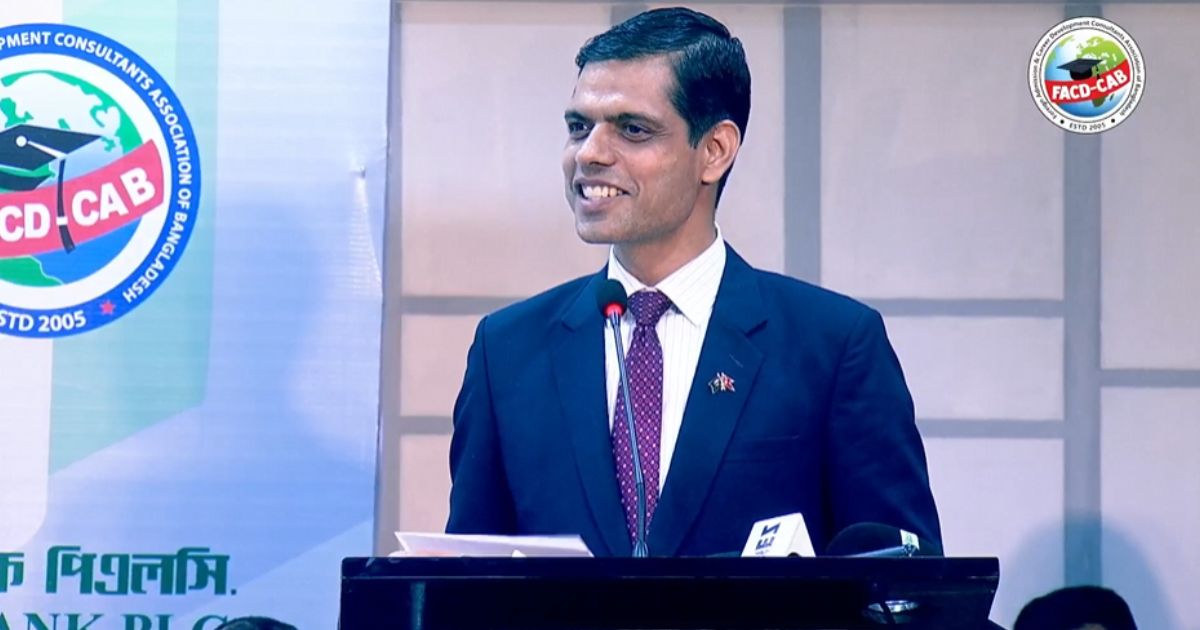
The morning after I arrived in Dhaka, I looked out of my hotel window and saw water already covering parts of the road. It had been raining throughout the night, and movement around the city was far from easy. We had a programme scheduled that day and had invited around sixty partners. Looking at the roads, I thought many of them would probably not make it. But forty-two people turned up.
Some had travelled for two hours. Others had spent more than three hours on the road just to reach the venue. One of our partners laughed and said, “Brother, floods come every year. Opportunities to meet like this do not come every year.” It was said casually, but the line stayed with me.
During my few days in Bangladesh, I noticed something similar again and again. There are problems, of course. Traffic is difficult, heavy rain can bring parts of the city to a standstill, and there are political and economic uncertainties like anywhere else. But people continue to work. Meetings continue. Business continues. People continue looking for the next opportunity. Of all the memories I brought back from Dhaka, the sight of people making their way through the rain simply to attend a meeting remains one of the strongest.
I have worked in international education for more than a decade, so whenever I visit another country, I naturally pay attention to students,
parents, education businesses, universities and the way the market is changing. Bangladesh was no different. But this time, I noticed that the conversation around overseas education has moved considerably.
There was a time when studying abroad in our part of the world largely meant choosing between Australia, the United Kingdom, the United States and Canada. Those countries remain important, but Bangladeshi students and parents are no longer limiting themselves to the traditional four destinations.
They are asking about different parts of Europe. They are exploring destinations in Asia. They want to know where quality education is available at a reasonable cost, what opportunities exist after graduation, whether scholarships are available, what work rights students have, and what their longer-term options may be.
What interested me even more was how well informed many parents already were before coming to speak with us. They often knew the tuition fees in different countries, the general visa situation, post-study work possibilities and even the career prospects attached to particular courses. Some had already compared five or six countries before sitting down with an education counsellor.
That changes the nature of our work as well. It is no longer enough to show a university brochure and say that a particular country is a good destination. Families are looking beyond admission. They are thinking about where their son or daughter may be five or ten years from now. International education has increasingly become part of a much bigger family decision.
This was also visible at the education expo in Dhaka. Parents were arriving with their children. Students would speak to one institution, move to another, come back with more questions, take notes and compare their options carefully. To me, it did not feel like a crowd simply looking for admissions. Many families appeared to be trying to understand where the next stage of their children’s lives might lead.
There is another reality we should also be willing to acknowledge. For many young people across South Asia today, overseas education is not only about earning a degree. They are looking for international exposure, employment, better opportunities and, in some cases, the possibility of building a longer-term life in another country.
We understand this very well in Nepal. In many Nepali families, one member may already be studying overseas, another working abroad, while someone else is preparing to leave. The same aspiration is clearly present in Bangladesh, but because of the size of its population, the scale feels much greater.
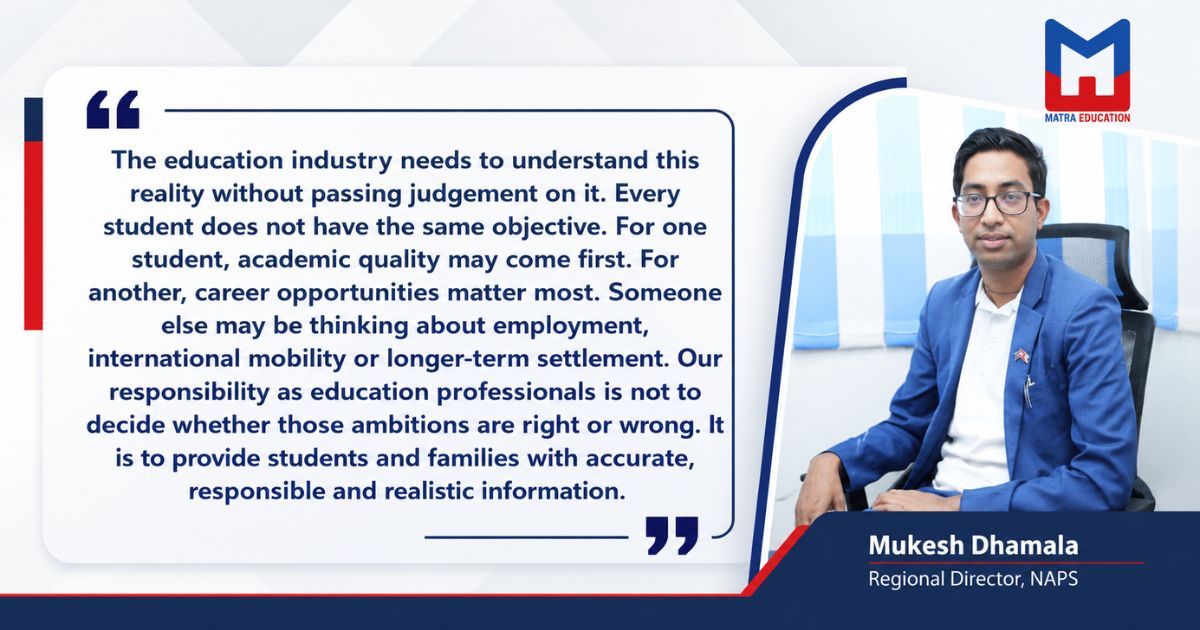
The education industry needs to understand this reality without passing judgement on it. Every student does not have the same objective. For one student, academic quality may come first. For another, career opportunities matter most. Someone else may be thinking about employment, international mobility or longer-term settlement. Our responsibility as education professionals is not to decide whether those ambitions are right or wrong. It is to provide students and families with accurate, responsible and realistic information.
Outside the formal programmes, I also had the opportunity to attend meetings at social clubs and private business gatherings in Dhaka. Those conversations showed me another side of Bangladesh. I met established businesspeople, professionals and families who were thinking very seriously about the future of their children.
The discussion in such places is different. It is not always about which university has the lowest fees or the highest ranking. People ask where their child will receive better exposure, what kind of career they can build after graduation, which countries may offer a stable future, and what other opportunities might exist for the family.
Sometimes a conversation that starts with education moves naturally into business. Sometimes it moves into tourism or opportunities between Bangladesh and Nepal.
Those conversations made me wonder whether we in Nepal have been looking at Bangladesh too narrowly, mainly as a source market for international students. Bangladesh can also be an important market for Nepal in tourism, business, education partnerships and broader people-to-people relations.
Many Bangladeshis already know something about Nepal. They know Kathmandu. They know Pokhara. The Himalayas naturally have a strong appeal. Some people I met had already visited Nepal, while others told me they wanted to come.
But interest and actual travel are two different things.
We Nepalis often say that our country is beautiful, and of course it is. But tourism does not grow on scenery alone. Visitors also need convenient air connectivity, good hotels, family-friendly services, clear information, suitable itineraries, good food options and promotion that actually reaches the right people.
There is considerable potential to attract Bangladeshi families, professionals and businesspeople with the ability and willingness to spend on quality travel. If we already travel to Dhaka for education expos, seminars and partner meetings, why should we not also think about tourism promotion, university collaboration and business networking at the same time?
One thing I also cannot leave out is Bangladeshi hospitality. We Nepalis come from a culture where guests are treated warmly, so much of it felt familiar. But once a relationship is established in Bangladesh, people genuinely give you their time. A meeting may end, but then comes lunch, tea, another introduction and perhaps another conversation. Sometimes their hospitality is stronger than your own schedule.
In business, this may appear like a small thing, but it is not.
Working with partners in different countries over the years has taught me that an email, presentation or agreement may begin a business relationship, but trust is built between people. I felt this particularly strongly in Bangladesh. That is why meetings outside conference halls also matter. A conversation over tea, a dinner, a social-club meeting or a simple office visit can sometimes lead to the next partnership or opportunity.
The presence of people from political, business, education and diplomatic circles at various programmes also showed that international education can no longer be treated simply as a consultancy or university matter. It is connected to a much wider economic activity, family decisions, skilled mobility, employment, business and relations between countries.
I was also encouraged to see a visible Nepali diplomatic presence in Dhaka. A diplomatic mission abroad should not be seen only in the context of official protocol. Connecting universities, bringing businesses together, promoting tourism and strengthening people-to-people relationships are also part of modern diplomacy.
For a country like Nepal, this kind of engagement matters even more. We may not have a large promotional budget in every market, but we can have the right people, institutions and networks in the right places. If the private sector, universities, the tourism industry and our diplomatic missions can work in their respective areas while thinking in the same direction, Nepal-Bangladesh relations can grow far beyond their present scope.
It would be wrong to claim that a few days in Bangladesh are enough to understand the country. I certainly do not claim that I came back having understood Bangladesh completely.
But I did return with a clearer sense of a few things. There is often a big difference between the market we see on paper and the market we understand after sitting with people. Statistics tell us about population, student numbers and economic size. Conversations tell us about aspirations.
In Dhaka, what struck me most was not simply the size of the market, but the scale of aspiration. Students want to go abroad. Parents want to secure a better future for their children. Businesses are looking for new partnerships. Professionals are looking for opportunities for themselves and their families. And within many of those conversations, there is also curiosity about Nepal.
We should not limit that curiosity to student recruitment. On the flight back to Kathmandu, I kept thinking that perhaps it is time for Nepal and Bangladesh to look at each other through a wider lens. Education can be a very good starting point, but once that door is open, it can lead to tourism, trade, university partnerships, professional exchanges and stronger people-to-people connections.
A student is never just a student. Behind that student is a family, and behind that family may be a much larger social and business network. Sometimes a relationship between two countries can begin with something as simple as one student choosing where to study.
So when we travel to Bangladesh, perhaps we should not return having looked only for students. We should look for good partners, build friendships, talk about tourism, explore business opportunities, connect universities and find more ways to bring the people of the two countries closer.
Large opportunities are not always found in large reports. Sometimes, a person who travels for three hours through the rain just to meet you can tell you much more. For me, that may be the most important memory I brought back from Dhaka.
(Writer Dhamala has been active in the international education sector for more than a decade, with experience in student recruitment, international education partnerships, market development and engagement with universities and education stakeholders across different countries. He currently serves as Regional Director for the National Academy of Professional Studies (NAPS) Australia.)