My career as a teacher started back in the year 2070 BS at a small private school in Okhaldhunga district. Since that first day, my journey has taken me to many different places. I have worked in five private schools and five government schools. Right now, I am teaching at my tenth school. I have spent more than ten years working in education. During this decade, I have experienced a lot of ups and downs. I have gathered many sweet memories that make me smile, but also some bitter ones that made me think deeply about how we treat children. When I first started out, it was completely normal for schools to use physical and mental punishment to make students behave. Teachers regularly punished children for simple things, such as: forgetting or not finishing their homework, having long hair, dyed hair, or unclipped nails, not wearing the exact school uniform or showing up looking a little messy and forgetting to bring their textbooks, notebooks, or pens to class. When I was a young student myself, and even during my first few years as a teacher, nobody thought twice about this. Almost everyone believed that hitting a student with a stick or yelling at them was the fastest and best way to fix a mistake. It was a deeply rooted tradition, and hardly anyone ever stopped to ask if it was actually doing any good.
Later on, I moved to Kathmandu to teach, which brought a whole new set of challenges. Some private schools there paid very low salaries, and they rarely paid their teachers on time. Because of this financial stress, many teachers, including myself, were forced to quit their jobs in the middle of the school year. We had to constantly look for other schools that paid a little better just to survive. Eventually, I started working at a private school that had a very strict “no-touch” rule. The entire school’s area was filled with security cameras. If a teacher used a stick or hit a student, they were immediately called to the principal’s office to explain themselves. Looking back, I realize this strict rule was completely right. Why should we ever raise our hands or a stick against another human being’s body? (I am not mentioning the name of this school because I do not want to advertise for them. Also, my departure wasn’t perfect; the management once withheld my original college documents to force me to stay for a full school year, which stopped me from going to other job interviews). Even though I had some personal issues with how that school was run, their way of teaching was wonderful. They truly believed in “learning by doing.” Instead of forcing students to sit still and memorize textbooks all day, they encouraged them to do projects, explore the outdoors, and conduct their own research based on the curriculum. Today, I look at those former students, and I see them doing amazing things as successful adults in many different jobs. On the other hand, in schools that rely heavily on strict rules, constant policing, and heavy punishments, I rarely see any real, positive growth in the students’ lives.
Today, it breaks my heart whenever I see news stories about students being badly beaten, mentally tortured, or publicly embarrassed by having their hair cut by force at school. Some of these stories are so tragic that students have even taken their own lives because of the extreme pressure they faced at school. Old-fashioned teachers who pride themselves on being strict might find it hard to accept these changing times. But we must stop and ask ourselves some hard questions: Is it really right to punish a child over the length of their hair, the state of their nails, or the clothes they wear? Are students learning for our sake, or for their own future? Why do we feel the need to control their personal lives and choices so much? Every human being, including every single child, has a fundamental right to live with dignity. Of course, this does not mean students can do whatever they want. It is never acceptable for students to disrupt classes, bully their peers, use bad language, or use drugs that ruin their ability to learn. Those behaviors are harmful and must be stopped. However, personal styles like having a beard, long hair, or unpolished nails have absolutely nothing to do with how smart a student is. Long hair does not stop a brain from thinking. History proves this point beautifully. Think about the world’s greatest thinkers, scientists, philosophers, and leaders. People like Socrates, Plato, Aristotle, Albert Einstein, Isaac Newton, Karl Marx, Leonardo da Vinci, and William Shakespeare often had wild, long hair and did not care at all about neat grooming rules. Yet, they were honest, deeply committed to their work, and changed human history forever. Real discipline cannot be forced out of someone through fear. When a student falls or makes a mistake, our role as teachers is to help them stand back up and become stronger. As they grow older and reach their teenage years, we need to trust them with personal responsibility. Once a student truly understands their own responsibility, you don’t need to force them to behave. They will naturally choose to do the right thing and will even become an example for others.
We are living in an era dominated by Google and Artificial Intelligence. Today, anyone can find facts, dates, and information in less than a minute using a smartphone. Because of this, it is completely wrong to test every single student using the exact same rigid exam system. Every child is different. They have different ages, different interests, and different natural talents. You cannot measure them all with the same yardstick. We must build schools where students can step away from boring textbook memorization. Instead, they need an environment where they can connect with nature, learn how the real world works, and do their own independent research. Learning practical, hands-on skills is far more valuable for a student’s future stability than just memorizing theories from a book to pass a test. When a school tries to control a student’s personal freedom or punishes them harshly for missing homework, it only creates anger and hatred. It turns the school from a safe haven into a scary, unfriendly place. It crushes a student’s self-esteem and makes them hate studying altogether. Force cannot teach morals or good behavior. Hitting a child might make them look obedient on the outside because they are scared, but on the inside, it fills them with anger and a desire for revenge. A school should be a place that opens a child’s mind, not a prison meant to lock them up and torture them under the excuse of keeping order.
When a student faces behavioral issues or learning difficulties, teachers should help them through kind, empathetic counseling and by understanding their emotions. Brute force is never the answer. But before we demand perfect discipline from our students, we as teachers must take a good look at ourselves in the mirror. Unfortunately, we see a lot of hypocrisy in our school systems today. There are teachers who come to school looking incredibly messy, ignore the uniform rules, smoke cigarettes on school grounds, or hang out drinking in local bars with community members. Some teachers walk into class completely unprepared, show up late, leave early, spend too much time scrolling on their mobile phones, make fun of others, or get involved in dirty politics. If a teacher acts this way, how can they ever expect a student to learn discipline? Students are like mirrors; they copy what their teachers do, not just what they say. As teachers, we need to study how top countries run their schools to produce great citizens. Our job is to guide learning, spark curiosity, keep students motivated, and teach them how to ask questions. We are mentors and guides, not prison guards or soldiers. To truly help a student improve, we must deeply understand their life outside the classroom, their family background, their financial situation, and their culture. A student is like soft, loose clay. The beauty, shape, and strength of the final statue depend entirely on the care, patience, love, and skill of the sculptor.
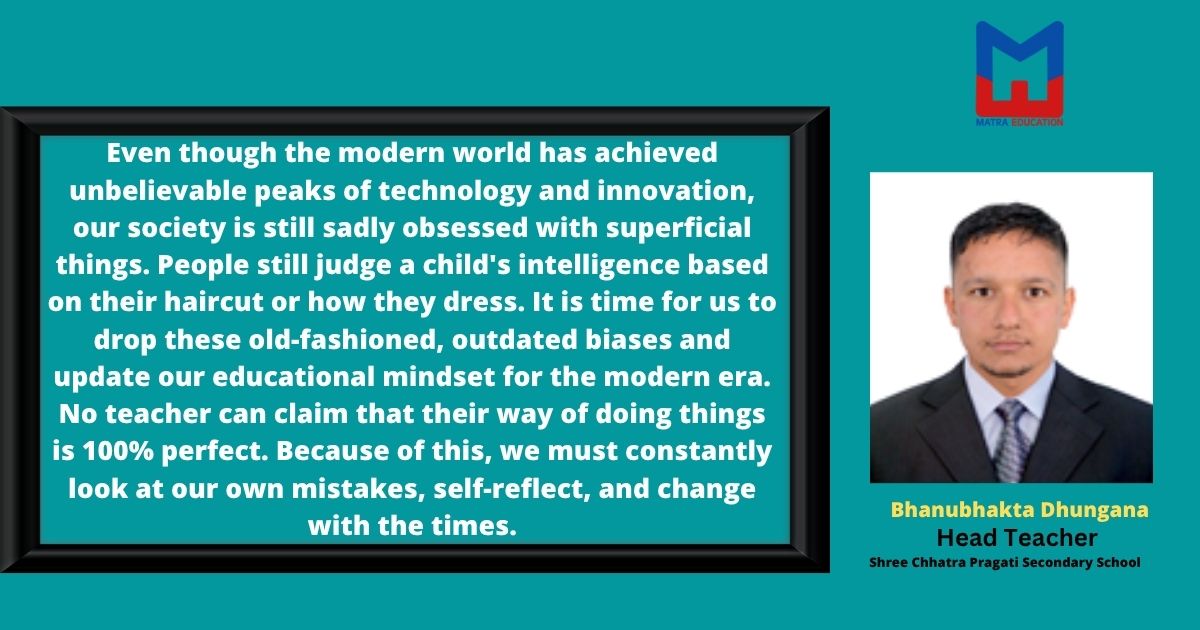
Throughout my years of teaching, I have tried my best to study and practice different educational ideas. My lived experience has taught me one absolute truth: punishing the students physically or mentally is a curse on education. It degrades their minds instead of helping them progress. Even though the modern world has achieved unbelievable peaks of technology and innovation, our society is still sadly obsessed with superficial things. People still judge a child’s intelligence based on their haircut or how they dress. It is time for us to drop these old-fashioned, outdated biases and update our educational mindset for the modern era. No teacher can claim that their way of doing things is 100% perfect. Because of this, we must constantly look at our own mistakes, self-reflect, and change with the times. Our main goal must be to create research-driven schools that shape students into happy, capable, and well-rounded citizens. While teachers play a massive part in this, we cannot do it alone. Raising a great generation is a shared duty that belongs equally to parents, society, and the entire education system.